
What does it mean to truly participate in Jewish communal life?
Not attend. Not observe. Participate.
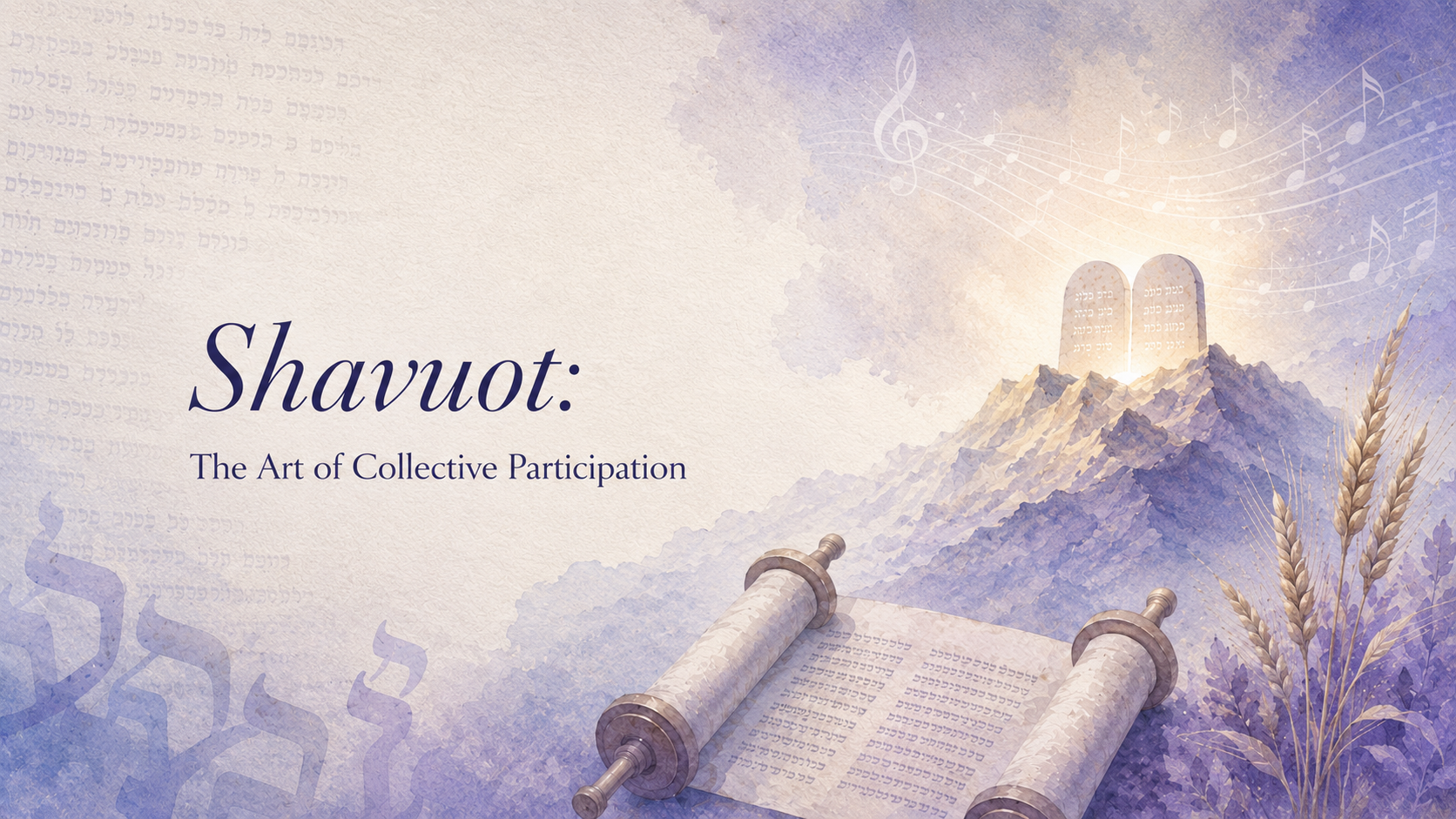
That question sat quietly beneath the surface of our latest Kulanu gathering as we prepared ourselves for Shavuot, the holiday of Mattan Torah, receiving Torah, and one of the great communal moments in Jewish memory.
As always, we began simply. What comes to mind when you think of Shavuot?
Cheese. Ruth. Agriculture. Yizkor. Baby animals. Torah.
The answers came quickly, but beneath them sat something deeper. Shavuot is a holiday layered with memory and meaning. It is agricultural and spiritual. Ancient and immediate. Personal and collective.
And perhaps most importantly, it is active. That became the center of our conversation.
When I was younger, teachers would describe Har Sinai as a sensory experience. Thunder. Sound. Voices. Fire. Presence. Not passive spectatorship, but full participation. Jewish tradition teaches not only that the Israelites stood at Sinai, but that every Jewish soul was present there too.
The language itself hints at this. We speak about Kabbalat Torah, receiving Torah. Receiving is an action. Torah is not simply placed before us. We must take it in.
That led us naturally into thinking about communal prayer and service leadership. What does it mean to help people move from passive observation into participation? When does a service feel alive, and when does it feel distant?
One participant reflected that music often determines whether they can enter the experience at all. Tempo matters. Emotional connection matters. Familiarity matters. A melody can either invite someone inward or leave them standing outside the moment.
Music in Jewish life is rarely decorative. It carries memory. It teaches. It creates emotional association. Sometimes it even becomes the structure through which we remember Torah itself. Many of us can chant passages because the trope lives within us. A tune does more than make prayer beautiful. It helps internalize it.
Another participant shared a story about attending a production of Shakespeare’s The Tempest. The opening storm scene was so immersive, with thunder, mist, movement, and sound, that the audience felt pulled directly into the chaos itself. The comparison may seem unexpected, but it sparked a fascinating reflection. Jewish ritual at its best also tries to engage the senses. Sinai itself is described as loud, overwhelming, impossible to ignore.
Of course, we are not recreating storms into the sanctuary anytime soon. Although someone did remind us of the Hasidic custom during Tefillat Geshem where water is splashed toward the chazzan while praying for rain. Perhaps Jewish tradition got there first after all.
As our conversation continued, another layer emerged. Shavuot is not only about Torah. It is also a harvest festival. Agriculture sits at the heart of the holiday, even if modern Jewish communities sometimes emphasize Sinai more than the fields.
Agriculture became an unexpectedly powerful lens for thinking about service leadership. Growth takes patience. Cultivation requires consistency. Nothing meaningful emerges instantly.
The same is true in communal prayer. Participatory communities are cultivated slowly. Comfort with singing develops over time. Shared repertoire forms gradually. Trust grows through repetition and familiarity. A Sea”tz is not merely leading words on a page. They are helping cultivate the conditions in which participation can flourish.
That idea carried directly into our singing. Much of the evening focused on building repertoire connected to Torah, joy, community, and celebration. Songs like Torah Tzivah, Ki MiTzion, Torat Hashem Temimah, and Ana Avda became examples of how communal familiarity creates communal confidence.
Torah feels alive when it becomes personally relevant. For some, certain parshiyot resonate deeply because they mirror real family experiences, sometimes painfully so. For others, the emotional realization of discovering familiar Friday night liturgy embedded directly within Torah text itself.
Toward the end of our discussion, we shared a passage that continues to shape our relationship with Torah for some. In Devarim 30:11-14 we are told that Torah is not far away. It is not in heaven. It is not across the sea. It is already close to us.
There is something profoundly empowering in that idea. Torah is not meant to remain distant, untouchable, or owned by someone else. It asks to be engaged with, struggled with, internalized, and lived.
Perhaps that is also true of prayer leadership. The role of the Sea”tz is not to perform Judaism for the community. It is to help the community enter into it together.
By the end of the evening, after melodies, conversation, and plenty of discussion about future gatherings, one participant offered a final suggestion: “Let’s host a Kulanu Shabbat dinner.”
It felt fitting. Because somewhere between Torah, agriculture, memory, music, and participation, Kulanu continues slowly becoming exactly what its name suggests: All of us together.
Some tunes to inspire us leading into the holiday:
- Torah Tzivah [YouTube | Apple Music | Spotify]
- Ki MiTzion [YouTube | Apple Music | Spotify]
- Torat Hashem [YouTube | Apple Music | Spotify]
- Ana Avda [YouTube | Apple Music | Spotify]
- Ki HaMitzvah Hazot [YouTube | Apple Music | Spotify]
- Mitzvah Gedolah [YouTube | Apple Music | Spotify]
- Baruch Eloheinu [YouTube | Apple Music | Spotify]
- Baruch Hamakom [YouTube | Apple Music | Spotify]
- Erev Shel Shoshanim [YouTube | Apple Music | Spotify]
- Al Kol Eileh [YouTube | Apple Music | Spotify]
- Ashorer Shira [YouTube | Apple Music | Spotify]