
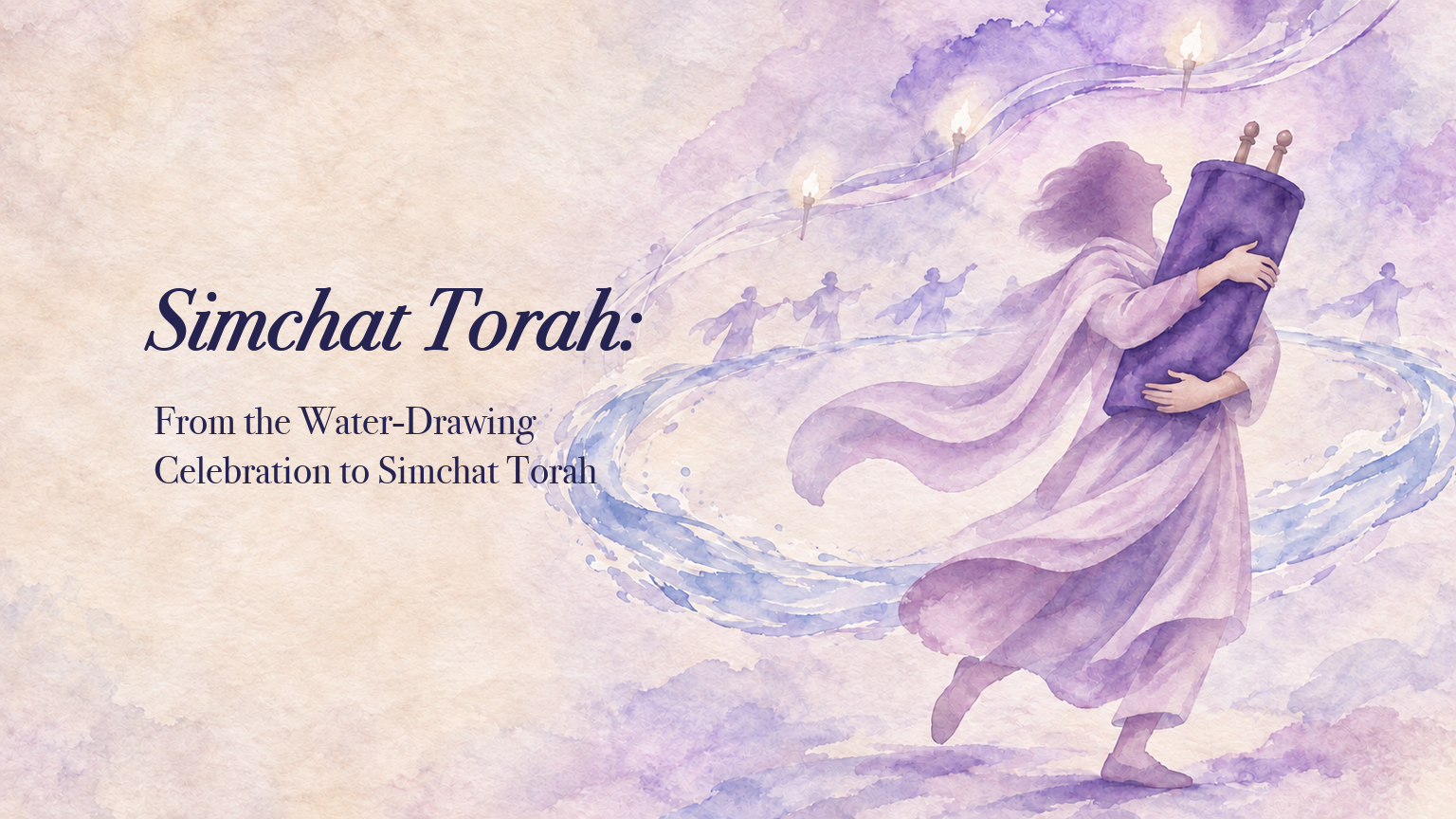
There are few times in the Jewish calendar when we are told so explicitly to be joyful as we are on Sukkot.
The Torah tells us, “V’samachta b’chagecha” — “You shall rejoice in your festival” and concludes the instruction with “v’hayita ach sameach” — “you shall have nothing but joy.” (Deuteronomy 16:13–15)
But how do we actually do joy?
Jewish tradition rarely leaves an important value as an abstraction. During Sukkot, our ancestors developed remarkably physical and communal ways of expressing simcha. We gathered. We sang. We danced. We processed together. We surrounded ourselves with light and music.
That story takes us from one of the most spectacular celebrations of the ancient Temple, Simchat Beit HaShoeva, to one of the most exuberant celebrations of the synagogue today, Simchat Torah.
Simchat Beit HaShoeva: When Jerusalem Celebrated
During Sukkot in the time of the Temple, a special water libation, nisukh hamayim, was offered on the altar. Water was drawn from the Shiloach and carried to the Temple in a ceremony connected with Sukkot and the coming rainy season. The imagery of Isaiah is particularly fitting: “Ush’avtem mayim b’sason mima’aynei hayeshuah” — “You shall draw water with joy from the wells of salvation.” (Isaiah 12:3; Sukkah 48b)
Around this ritual developed the Simchat Beit HaShoeva, literally the “Rejoicing at the Place of the Water Drawing.”
Calling it a celebration almost understates what the rabbis describe.
The Mishnah famously declares:
מי שלא ראה שמחת בית השואבה לא ראה שמחה מימיו
“One who has not seen the rejoicing at the Beit HaShoeva has never seen rejoicing in their life.”
The description that follows is extraordinary. Enormous golden lamps illuminated the celebration. The Mishnah says that there was not a courtyard in Jerusalem that was not lit by their light. Pious and distinguished participants danced while holding flaming torches, singing words of praise. The Levi’im stood with harps, lyres, cymbals, trumpets, and other instruments on the fifteen steps descending from the Court of the Israelites to the Women’s Court, corresponding to the fifteen Shir HaMa’alot, the Songs of Ascents found in Psalms 120–134. (Mishnah Sukkah 5:2–4)
The Talmud adds even more colour. Rabban Shimon ben Gamliel is described juggling eight flaming torches without one touching another. Rabbi Yehoshua ben Hananiah describes a Sukkot schedule so full of worship, study, offerings, prayer, and celebration that people scarcely slept in the conventional sense. (Sukkah 53a)
This was not music added to a religious ceremony to make it more enjoyable.
The music, movement, light, and collective participation were part of the religious experience itself.
Maimonides captures this particularly well centuries later. Describing the Sukkot celebration, he writes of people playing instruments, singing, dancing, clapping, and celebrating, each according to their ability. He characterizes this extraordinary joy in performing the mitzvot and loving God as itself a form of divine service. (Mishneh Torah, Shofar, Sukkah and Lulav 8:12–15)
After the destruction of the Temple, the water libation could no longer be performed. But the instinct behind the celebration survived. Jewish communities continue to mark Simchat Beit HaShoeva during Chol HaMoed Sukkot with gatherings centred around singing, dancing, Torah learning, and communal celebration. (My Jewish Learning: Simchat Beit HaShoavah)
Simchat Torah: From Water to Torah
At the other end of Sukkot comes another celebration built around singing, dancing, and movement: Simchat Torah.
Interestingly, Simchat Torah is not a biblical festival in its own right. The Torah establishes Shemini Atzeret, but the celebration we recognize as Simchat Torah developed considerably later as Jewish communities established regular cycles for the public reading of Torah.
Ancient Jewish communities did not all read through the Torah according to the same schedule. The Babylonian tradition developed an annual cycle, while communities in Eretz Yisrael used longer cycles. The Babylonian annual cycle eventually became standard, and the completion of Deuteronomy became associated with the end of the festival season. Over the medieval period, customs of celebrating that completion through processions, singing, and dancing increasingly developed into Simchat Torah as we know it. (My Jewish Learning: How Simchat Torah Came to Be)
At the heart of the day is one of Judaism’s simplest and most powerful ritual choices.
We finish the Torah and immediately begin again.
We read the final verses of Vezot HaBerakhah, including the death of Moshe and the conclusion of Deuteronomy. Then another scroll is opened and we return immediately to:
בראשית ברא אלהים — “In the beginning, God created…”
There is no moment in which we can declare ourselves finished with Torah. The end leads directly back to the beginning. Torah learning is not a book to complete but a cycle we continually re-enter.
And once again, Jewish tradition does not express that idea only intellectually.
We dance with it.
Hakafot: Putting Torah at the Centre
The defining communal ritual of Simchat Torah is the hakafot, traditionally seven circuits in which Torah scrolls are carried through the synagogue accompanied by singing and dancing. (My Jewish Learning: The Simchat Torah Evening Service)
There is something striking about what happens to the Torah scroll during hakafot.
Normally, when we remove a Sefer Torah from the ark, we are taking it somewhere. We process with it so that we can arrive at the bimah, open it, and read from it.
During hakafot, the procession itself becomes the destination.
We carry Torah around the community. We pass it from person to person. We sing while holding it. We dance around it. Torah moves from being primarily the text we study to the physical centre around which the community moves.
Simchat Torah also developed customs emphasizing broad communal participation. Communities traditionally seek to provide many people with aliyot, sometimes repeating sections of the reading or establishing multiple reading stations. Children are brought prominently into the celebration, and special honours developed for those called for the conclusion of Deuteronomy, Chatan/Kallat Torah, and the beginning of Genesis, Chatan/Kallat Bereishit. (My Jewish Learning: The Torah Service for Simchat Torah)
There are differences in how the festival is observed geographically and denominationally. In Israel, Shemini Atzeret and Simchat Torah coincide on a single day. Traditional Diaspora communities observe Shemini Atzeret on the first day and Simchat Torah on the second, while some liberal communities follow the one-day pattern. (My Jewish Learning: History of Shemini Atzeret and Simchat Torah)
Yet across those variations, the central instinct remains remarkably recognizable: Torah becomes an occasion for collective joy.
Kulanu: How a Community Creates Simcha
There is a fascinating connection between these two celebrations.
Simchat Beit HaShoeva: water, light, music, singing, and dancing.
Simchat Torah: Torah, hakafot, music, singing, and dancing.
They emerged in radically different Jewish worlds. One belongs to the Temple in Jerusalem and the other developed in the post-Temple synagogue. Yet both suggest something important about how Judaism understands simcha.
Joy is not merely an emotion we wait to experience.
We create the conditions for it.
We gather people together. We give them something sacred around which to gather. We sing. We move. We repeat melodies until people who began as listeners become participants.
That last point is particularly important for our work in Kulanu.
When we learn the melodies for hakafot, the goal is not simply to produce more knowledgeable service leaders or to expand our repertoire of Jewish music. We are learning one of the tools through which a congregation becomes a community.
A melody known only by the person leading it remains a performance.
A melody that the room knows becomes something else entirely.
Suddenly people can join in. They can carry the Torah and sing without needing a siddur. Children can participate alongside adults. Someone who does not know the liturgy particularly well can still become part of the ritual. The boundary between leader and congregation begins to disappear.
Perhaps that is one of the threads connecting the extraordinary celebration described in Mishnah Sukkah with the hakafot we celebrate today.
The objects have changed. The setting has changed. The ritual has changed.
But the Jewish instinct is remarkably persistent:
When there is something worth celebrating, we gather around it, raise our voices, and create the joy together.